
Understanding Residual TFA in Synthetic Peptides
A research-focused explanation of trifluoroacetate counterions, net peptide content, and how residual TFA should be interpreted in peptide documentation.
Residual TFA is one of those details that can look minor on a Certificate of Analysis while carrying real interpretive weight. In synthetic peptide documentation, TFA usually refers to trifluoroacetic acid or its conjugate base, trifluoroacetate. It commonly appears because TFA is used during solid-phase peptide synthesis, cleavage, deprotection, and reverse-phase HPLC purification. Even after purification and lyophilization, some trifluoroacetate may remain associated with the peptide material.
That does not mean a peptide lot is automatically misidentified or poorly made. It means the material is not just a bare peptide sequence floating in isolation. A synthetic peptide can exist as a salt form, with counterions balancing charged groups on the molecule. For research documentation, the useful question is not whether TFA exists as a scary-looking acronym. The useful question is whether the reported composition, identity data, purity method, and net peptide content are clear enough to interpret the lot honestly.
Why TFA appears in peptide workflows
Many peptides are produced by solid-phase peptide synthesis. During that workflow, protecting groups are added and removed, peptide bonds are assembled step by step, and the final material is cleaved from a resin support. TFA is widely used in cleavage and deprotection chemistry because it can remove acid-labile protecting groups and release the peptide under established process conditions. It also appears in many analytical and preparative HPLC methods as a mobile-phase modifier that improves peak shape for charged peptide molecules.
Those roles explain why residual trifluoroacetate can be present after manufacturing. Peptides often carry basic sites, especially when lysine, arginine, histidine, or terminal amines are present. Counterions can associate with those charged sites. Lyophilization removes volatile solvent and water, but it does not magically convert every charged association into a counterion-free material. The resulting powder may contain peptide, counterions, residual moisture, salts, and trace process-related species within the limits of the manufacturing and purification system.

Gross vial mass is not net peptide content
Residual TFA matters most when a reader confuses gross vial mass with net peptide content. A vial labeled with a nominal fill amount is not necessarily composed entirely of target peptide free base by mass. Counterions and residual water can contribute to the weighed material. Net peptide content attempts to describe how much of the material corresponds to the peptide itself, separate from associated salts, counterions, and moisture. This is why a COA may report purity, peptide content, water content, and counterion information as separate fields rather than one all-purpose number.
HPLC purity does not solve this by itself. HPLC purity is usually an area-percent measure under a specific chromatographic method. It describes the proportion of detected UV-absorbing species represented by the main peak compared with related peaks. It does not directly report total peptide mass in the vial, counterion mass, water content, or identity. Mass spectrometry addresses molecular identity. Karl Fischer or related methods may address water. Ion chromatography, elemental analysis, NMR, or validated manufacturer methods may be used to characterize counterions depending on the lot and specification.
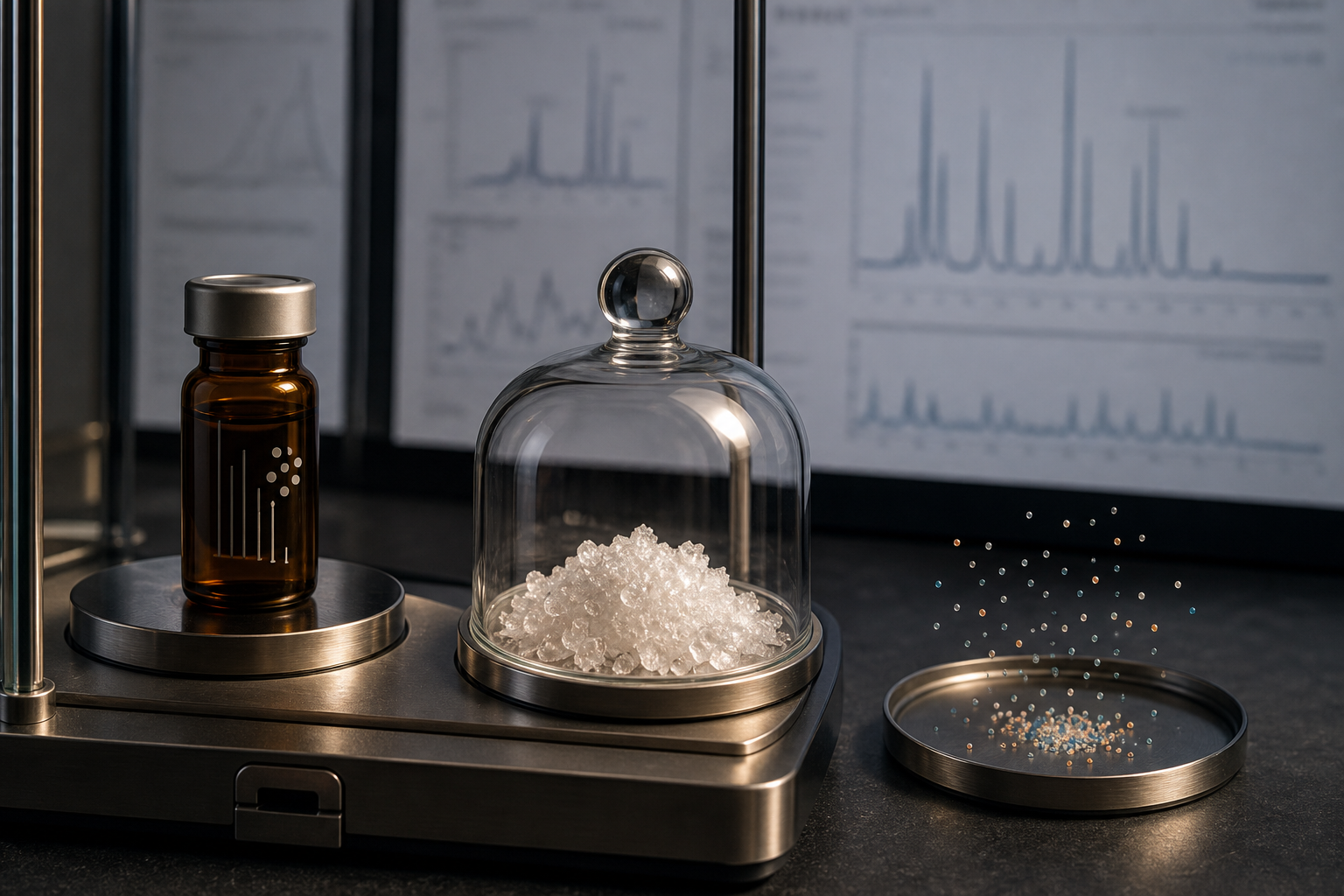
Salt form and counterion exchange
Some peptide lots are intentionally supplied or further processed as acetate, chloride, trifluoroacetate, or other salt forms. Counterion exchange can be part of a manufacturing request or purification strategy, but it is not just a cosmetic label change. Exchange efficiency depends on sequence, charge state, purification method, drying conditions, and analytical confirmation. A supplier should avoid implying that a salt form has been changed or minimized unless the documentation supports that statement for the specific lot.
This is also where comparison language can become sloppy. A lower residual TFA value may be relevant for certain research specifications, but the number only means something when the method, acceptance criteria, and lot context are available. A clean analytical posture is to state the salt form and counterion information that the manufacturer reports, distinguish manufacturer documentation from independent testing when both exist, and avoid broad claims that leap from composition data to end-use suitability.
Residual TFA is not a single quality verdict. It is one composition detail that has to be read beside identity, purity, water content, and lot-specific methods.
How CRL should talk about residual TFA
For CRL Journal purposes, residual TFA belongs in the same documentation family as HPLC purity, mass spectrometry identity, net peptide content, and lot traceability. The language should stay analytical: what was measured, who measured it, which lot it applies to, and which method produced the value. When a manufacturer COA reports counterion content, that value should be presented as manufacturer-provided documentation unless independent testing has confirmed it separately.
The conservative wording is simple. TFA can remain from established peptide synthesis and purification workflows. Counterions and residual moisture can make gross vial mass differ from net peptide content. HPLC purity, identity confirmation, water content, and counterion data answer different questions. No single field should be stretched beyond its method. That kind of precision is less flashy than broad quality language, but it is more useful for qualified researchers reviewing RUO materials.
- TFA commonly appears because of peptide cleavage, deprotection, and HPLC purification workflows.
- Trifluoroacetate can act as a counterion for charged peptide sites.
- Gross vial mass, HPLC purity, and net peptide content are different measurements.
- Salt-form or counterion claims should be tied to lot-specific documentation.
- Manufacturer COA values and independent analytical results should be labeled by source.
Related Journal entries include How to Read a Peptide Certificate of Analysis, HPLC vs Mass Spectrometry, Lyophilization 101, and Lot Numbers, Batch Records, and Why Traceability Matters. Residual TFA sits between those topics: it is chemistry, documentation, and measurement discipline all at once.
Research Use Only
This product is supplied strictly for laboratory research workflows. It is not offered for food, drug, cosmetic, veterinary, agricultural, or household use. By purchasing, the buyer represents they are a qualified researcher and accepts all responsibility for proper handling, storage, and lawful research use.