
Peptide Degradation Kinetics: Temperature, Light, Oxidation, and Freeze-Thaw
A research-focused guide to the chemical and environmental factors that can change peptide material over time.
Peptide stability is a chemistry problem before it is a logistics problem. A synthetic peptide can leave a manufacturer with a clean Certificate of Analysis, matching lot documentation, and appropriate labeling, then gradually change as it encounters temperature, moisture, light, oxygen, or repeated handling events. Those changes do not have to be dramatic to matter in a research setting. Small shifts in purity, identity-related signals, or impurity profile can make analytical records harder to interpret over time.
The term degradation kinetics refers to the rate at which those changes occur under defined conditions. A kinetic statement is only meaningful when the conditions are described: physical form, container closure, temperature range, light exposure, oxygen exposure, moisture exposure, time interval, and analytical method. Without that context, broad shelf-life language becomes a claim without a measurement system behind it.
Why peptide degradation is condition-specific
Peptides are not one chemical class with one stability profile. Sequence length, amino acid composition, terminal modifications, salt form, residual moisture, counterions, and lyophilization quality can all influence how a material behaves during storage. Methionine, cysteine, tryptophan, asparagine, glutamine, and other residues can participate in different degradation pathways depending on the surrounding sequence and environment.
That is why responsible research documentation avoids universal stability promises. A storage recommendation may reduce risk, but it does not replace lot-specific analytical review or controlled stability data. The stronger statement is narrower: lower temperature, limited light exposure, sealed storage, and reduced moisture exposure are common risk controls for research peptide materials, but actual stability depends on the compound and the conditions under which it is evaluated.
Temperature and time
Temperature affects molecular motion and reaction rate. As temperature rises, many chemical degradation pathways proceed faster. That general principle explains why lyophilized peptide materials are commonly stored cold and protected from avoidable temperature excursions. It also explains why shipping documentation, receiving records, and storage logs belong in the same quality conversation as COAs and lot numbers.
Temperature exposure is not just a single number. Duration matters. A brief, documented transfer event is different from prolonged uncontrolled storage. A sealed container held cold is different from one repeatedly opened in a humid room. Kinetic interpretation depends on the accumulated exposure history, not merely the label claim printed at receipt.
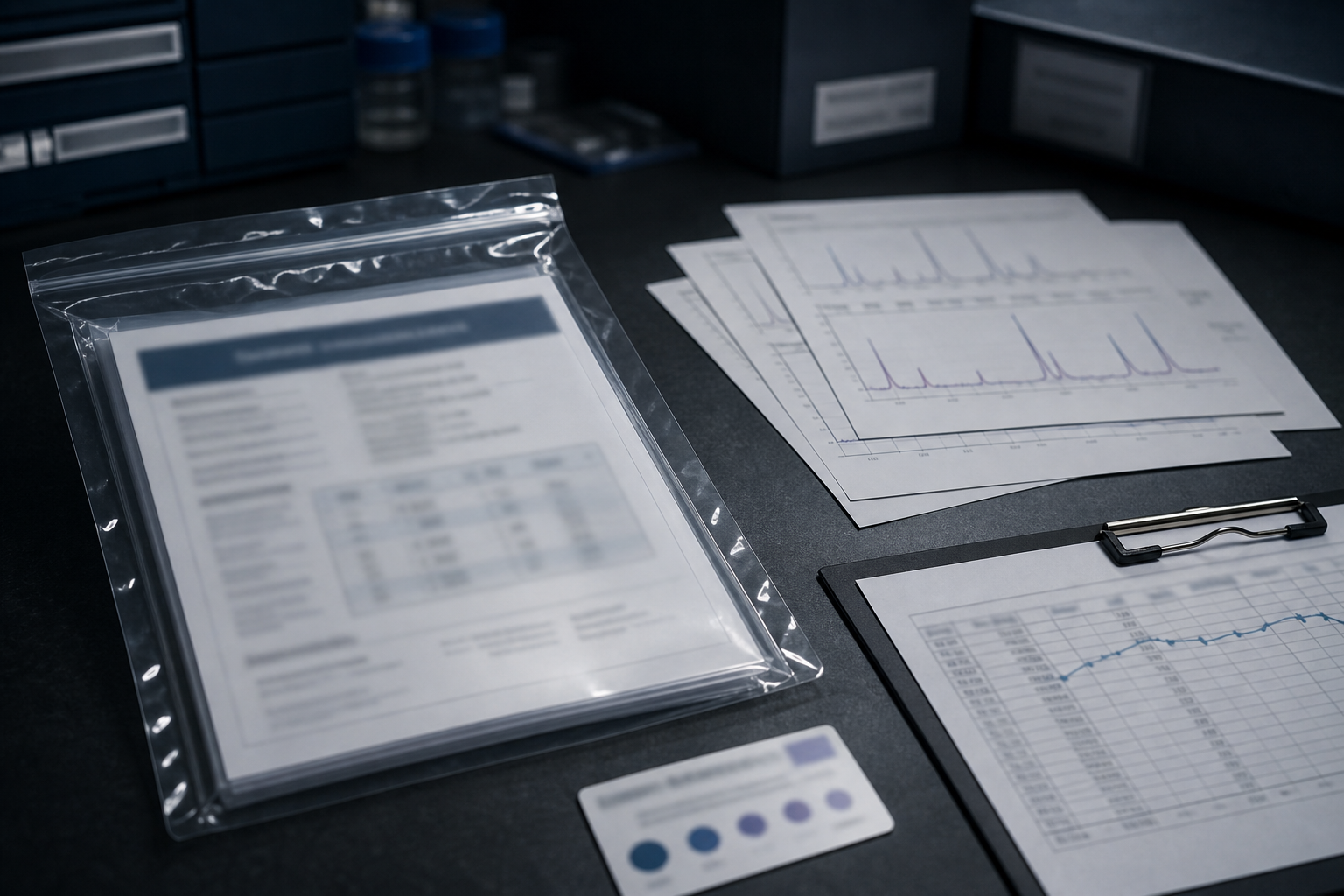
Cold storage also has limits as a communication shortcut. Saying that a material was held at a target temperature does not prove that the material remains unchanged. It only describes one control applied to reduce known risks. Analytical confirmation still comes from methods such as HPLC and mass spectrometry, interpreted against a lot-specific record.
Light, oxygen, and moisture
Light exposure can contribute to photochemical changes in susceptible compounds. The practical research documentation response is straightforward: use packaging and storage practices that reduce unnecessary exposure, and avoid presenting light-protection language as proof of stability. A light-protected package is a risk control, not a substitute for analytical evidence.
Oxygen exposure is another variable. Oxidation can alter residues that are chemically susceptible under the relevant conditions. The result may appear as additional peaks in a chromatogram, a shifted mass signal, or a changing impurity pattern. The exact interpretation depends on the compound, the method, and the reference record for the lot.
Moisture can matter even when a peptide is shipped as a dry powder. Lyophilized material may still contain residual water, and container closure integrity affects how much additional moisture can enter during storage. Moisture does not act alone; it interacts with temperature, exposure time, and the physical state of the material. This is why sealed storage and disciplined handling records are part of serious research inventory control.

A storage condition is not a stability result. It is the context that makes a stability result interpretable.
Freeze-thaw events and analytical interpretation
Freeze-thaw language is often used too loosely. In a research documentation context, the useful question is not whether a phrase sounds cautious. The useful question is what physical state was frozen, how often the event occurred, whether the container remained sealed, and what analytical method was used to evaluate any later change. A lyophilized powder, a frozen solution-state research sample, and a partially thawed sample are not interchangeable scenarios.
Repeated thermal cycling can introduce stress through temperature change, condensation risk, and handling exposure. Those risks are why inventory systems often favor aliquot planning, minimal opening events, and clear storage logs for research materials. The Journal has already covered lyophilization as a preservation method and cold-chain logistics as a shipping control; degradation kinetics connects those topics to the chemical question of what may change over time.
For CRL, the conservative editorial position is to separate handling recommendations from claims about unchanged material. Manufacturer COAs report the lot at the time of testing. Shipping and receiving records describe custody and exposure controls. Future independent analytical testing, when available, should be labeled by source, lot, date, and method. Each record answers a different question.
- Temperature records document exposure conditions; they do not prove continued purity.
- Light-protective packaging reduces one class of risk; it is not a universal stability claim.
- Oxidation and moisture effects depend on compound structure, physical form, and storage history.
- Freeze-thaw interpretation requires knowing the physical state, container status, and number of cycles.
- Lot-specific analytical methods remain the proper way to evaluate identity and impurity changes.
Related Journal entries include Lyophilization 101, Cold-Chain Logistics for Research Compounds, Lot Numbers and Batch Records, and How to Read a Peptide Certificate of Analysis. Together, those topics describe the documentation chain around peptide materials: what the lot was, how it was reported, how it moved, and which conditions may affect later analytical review.
Research Use Only
This product is supplied strictly for laboratory research workflows. It is not offered for food, drug, cosmetic, veterinary, agricultural, or household use. By purchasing, the buyer represents they are a qualified researcher and accepts all responsibility for proper handling, storage, and lawful research use.