
Lyophilization 101: Why Research Peptides Ship as Powder
Freeze-drying is the standard preservation method for synthetic peptides. Understanding the process clarifies handling requirements and storage constraints.
Lyophilization, also called freeze-drying, is a dehydration process in which a sample is first frozen and then placed under reduced pressure. Under these conditions, frozen water sublimes directly from solid to vapor without passing through a liquid phase. The result is a dry porous solid that retains the chemical structure of the original material with substantially reduced susceptibility to degradation.
Why peptides are lyophilized
Peptides in aqueous solution are susceptible to hydrolysis at the peptide bond, oxidation of susceptible residues such as methionine and cysteine, and microbial contamination. Removing water eliminates the primary medium through which these degradation pathways operate. Properly lyophilized peptide material stored at minus twenty degrees Celsius in sealed amber glass has been documented to remain stable for multi-year periods under validated conditions.
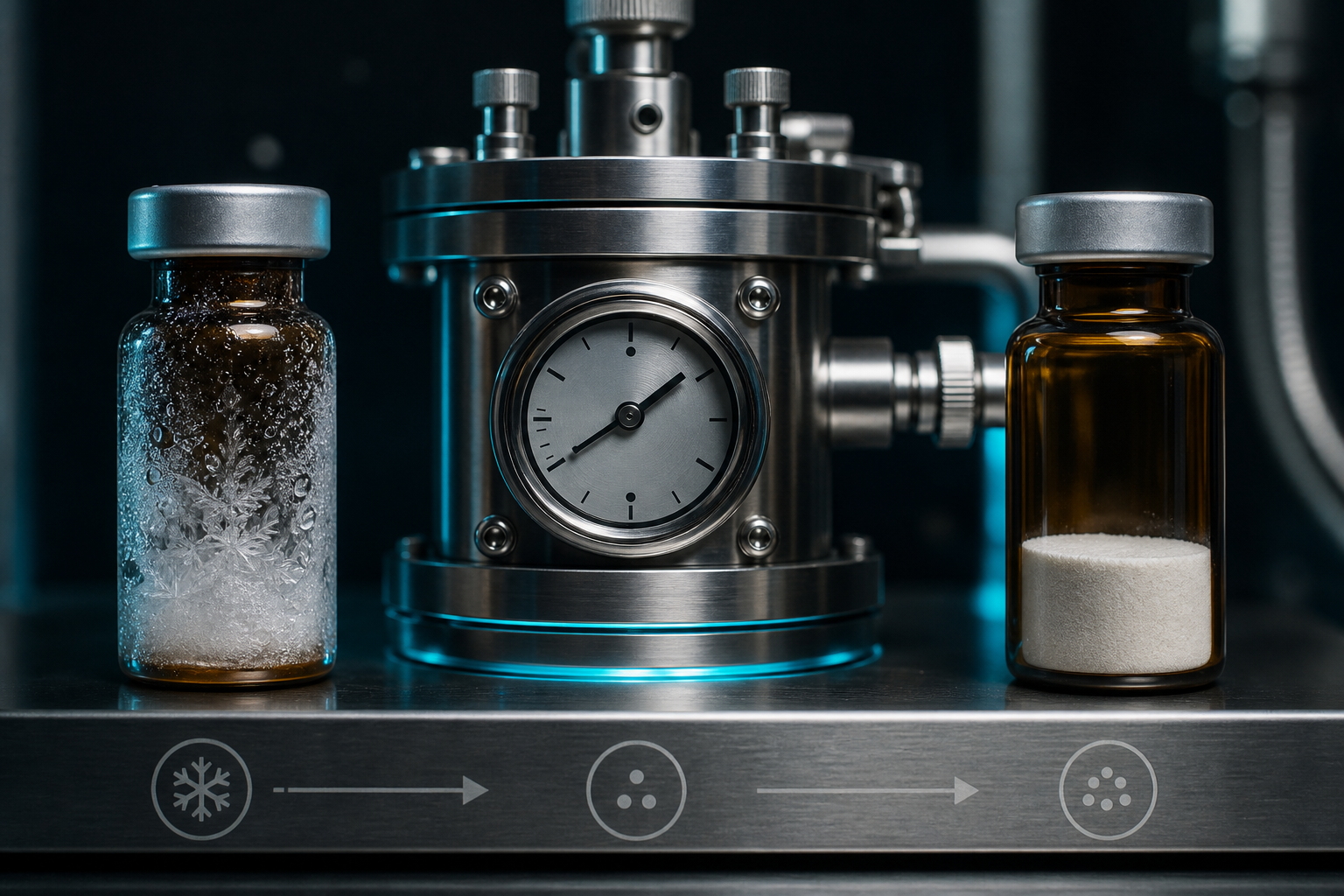
The freeze-drying cycle
- Freezing: the aqueous peptide solution is cooled below its eutectic point, converting the sample to a solid matrix.
- Primary drying: chamber pressure is reduced and shelf temperature is raised incrementally, driving sublimation of the bulk water fraction. This stage removes approximately 95 percent of moisture.
- Secondary drying: temperature is raised further to remove residual bound moisture. Final moisture content in a well-executed cycle is typically below one percent by mass.
Lyophilization does not eliminate degradation pathways. It slows them substantially by removing the aqueous medium those pathways require.
Implications for handling
For documentation review, lyophilized research materials should be evaluated by the conditions stated for the specific lot, packaging configuration, and analytical method. Moisture exposure, temperature history, container closure, and elapsed time can all affect the interpretation of stability records. A responsible record keeps those variables attached to the lot rather than turning general freeze-drying principles into universal handling claims.
Research Use Only
This product is supplied strictly for laboratory research workflows. It is not offered for food, drug, cosmetic, veterinary, agricultural, or household use. By purchasing, the buyer represents they are a qualified researcher and accepts all responsibility for proper handling, storage, and lawful research use.