
HPLC vs. Mass Spectrometry: What Each Tells You About a Synthetic Peptide
HPLC and mass spectrometry answer different analytical questions; understanding the distinction helps researchers read peptide documentation without confusing purity with identity.
Two numbers often sit near the center of peptide documentation: a chromatographic purity percentage and a mass spectrometry identity result. They are related, but they are not interchangeable. High-performance liquid chromatography, usually abbreviated HPLC, separates material in a sample and estimates relative composition under a stated method. Mass spectrometry, usually abbreviated MS, measures mass-to-charge signals that help confirm whether the target molecule is present.
The difference matters because a peptide lot can look strong by one method and still require the other method to complete the analytical picture. A clean chromatogram does not, by itself, prove molecular identity. A mass signal near the expected molecular weight does not, by itself, describe every impurity in the sample. Good documentation uses the methods as complementary records, not substitutes.
What HPLC is actually measuring
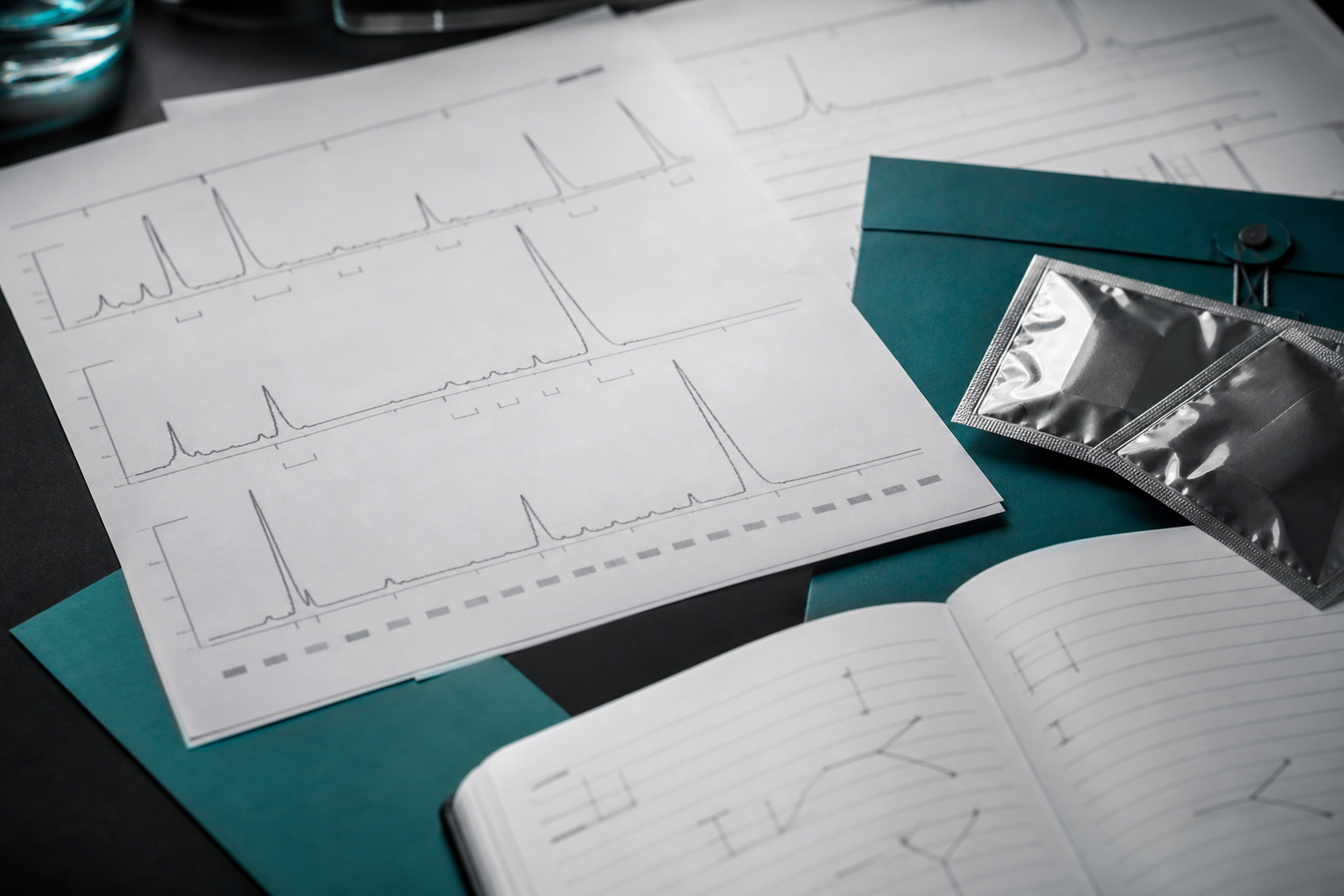
In reverse-phase HPLC, a prepared sample is introduced onto a column and carried through the system by a liquid mobile phase. Different components interact with the stationary phase and mobile phase differently, so they elute from the column at different retention times. A detector records those eluting components as peaks. For many peptide methods, ultraviolet detection near the peptide bond absorption range is used to produce a chromatogram.
The purity percentage reported on a Certificate of Analysis is typically an area percentage. The area under the main peak is compared with the total area under all integrated peaks detected by that method. If the main peak accounts for 98 percent of the integrated area, the report may list 98 percent HPLC purity. That number describes the relative signal distribution observed during that run. It does not mean 98 percent of the vial mass is target peptide, and it does not independently prove that the main peak is the intended sequence.
What mass spectrometry adds
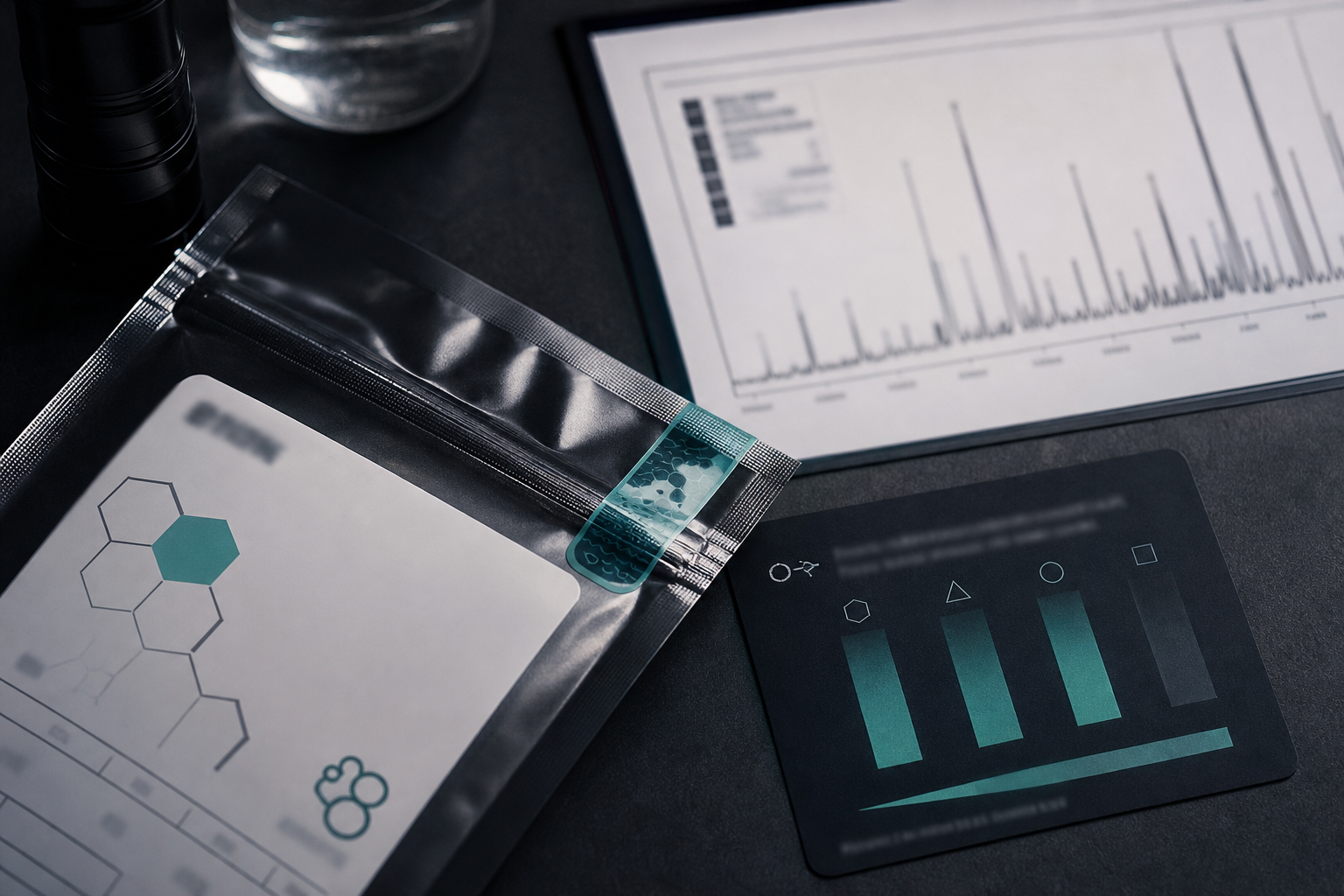
Mass spectrometry approaches the sample from a different direction. Instead of separating components by retention behavior, MS ionizes molecules and measures mass-to-charge ratios. For peptide documentation, the report usually compares the theoretical molecular weight of the target compound with an observed mass signal. A close match supports identity because the observed molecule has a mass consistent with the expected peptide.
This is why MS appears in COA documentation as an identity check. If the theoretical mass and observed mass align within the method's acceptance criteria, the report has evidence that the target molecular species is present. But a basic MS identity result is not the same as full sequence mapping, nor does it automatically quantify every related impurity. Isobaric or near-isobaric species, adducts, salts, counterions, and method conditions can all complicate interpretation.
In practical documentation review, the strongest reading comes from looking at the HPLC and MS records together. HPLC asks how much of the detected chromatographic signal belongs to the main component. MS asks whether the measured mass of that component is consistent with the intended molecule. The two methods answer different questions, and both questions matter.
Common documentation mistakes
The most common mistake is treating a purity percentage as a universal quality statement. A line that says 98 percent by HPLC is not a claim about sterility, endotoxin, residual solvents, water content, salt form, net peptide content, or stability. Those require different measurements or different documentation. HPLC area percentage is useful, but it is narrower than the way it is often quoted in sales copy.
A second mistake is treating mass confirmation as comprehensive sequencing. A mass result can support identity, but a single molecular weight match does not necessarily distinguish every structural possibility. Higher-resolution methods, tandem MS workflows, sequence-specific fragmentation, and orthogonal analytical records may be needed for more demanding questions. The appropriate level of evidence depends on the research context and the documentation standard being applied.
- HPLC purity reports relative chromatographic area under a stated method.
- MS identity confirmation compares observed mass with theoretical molecular weight.
- Neither method alone establishes every property a research buyer may want to know.
- A manufacturer COA is strongest when summary values are paired with raw chromatograms, spectra, lot identifiers, and method details.
How CRL reads these records
CRL uses HPLC and MS as documentation inputs, not marketing shortcuts. A manufacturer COA when available should be read as a lot-specific analytical record. The HPLC section helps describe relative purity under the reported chromatographic method. The MS section helps support identity by comparing observed mass with expected mass. Neither section should be stretched into claims the document does not support.
This article also connects to two earlier Journal topics. The COA field guide explains where these values appear on a typical peptide certificate, while the COA integrity article explains why a summary page is only as strong as the records and chain of custody behind it. Future Journal entries will go deeper into chromatogram integration, molecular weight versus sequence confidence, and the limits of supplier-side documentation.
The cleanest documentation separates what was measured, what was inferred, and what remains untested.
All products sold by Chubby Rabbit Labs are supplied strictly for laboratory research workflows. They are not offered for food, drug, cosmetic, veterinary, agricultural, or household use. For qualified researchers only.
Research Use Only
This product is supplied strictly for laboratory research workflows. It is not offered for food, drug, cosmetic, veterinary, agricultural, or household use. By purchasing, the buyer represents they are a qualified researcher and accepts all responsibility for proper handling, storage, and lawful research use.