Longevity & Cellular
5-Amino-1MQ
From$180
1 size
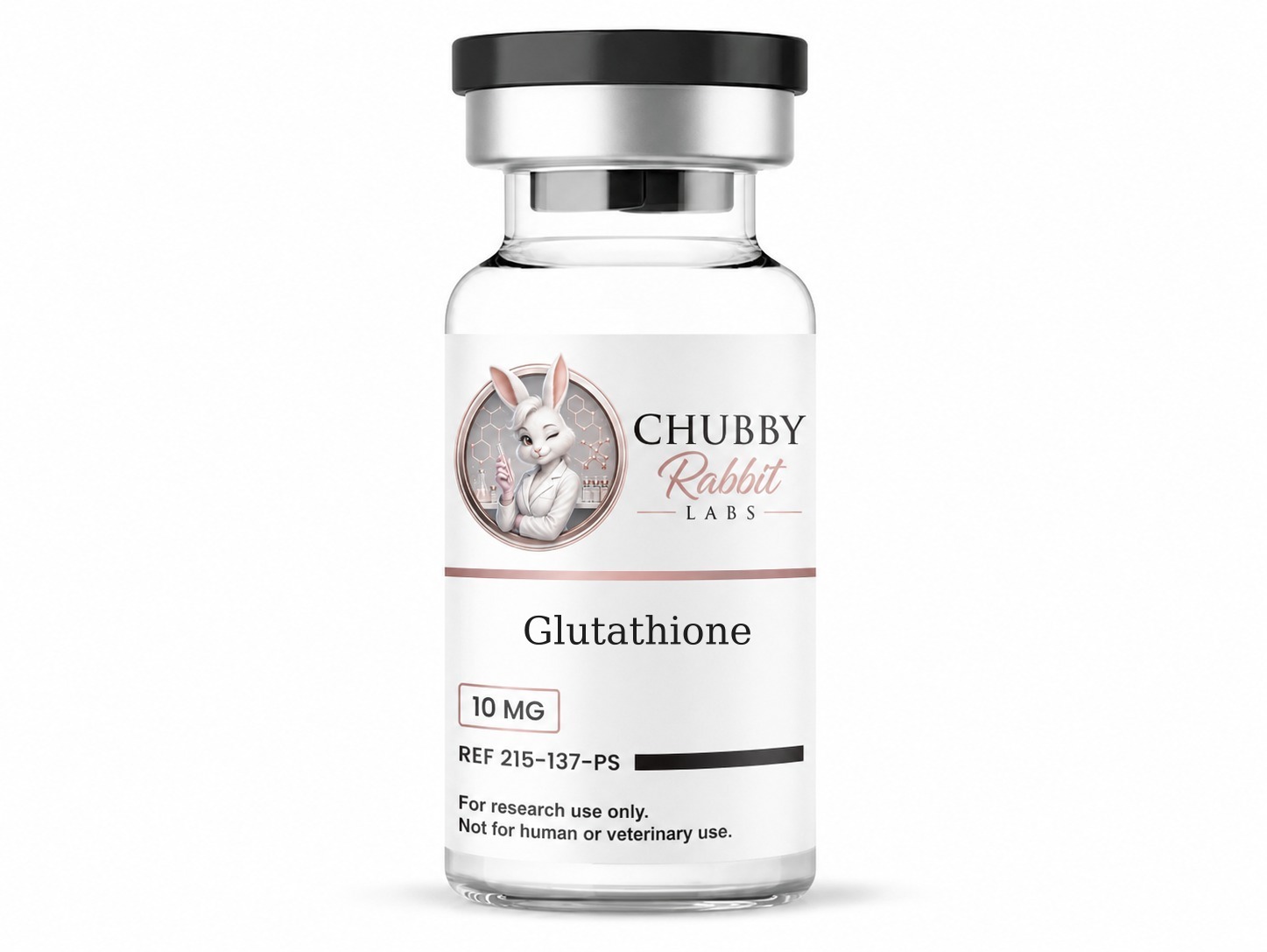
Research use only
Order 3+ and save. Contact us for bulk pricing.
Glutathione (GSH) is a tripeptide composed of glutamate, cysteine, and glycine (γ-Glu-Cys-Gly), present at millimolar concentrations in virtually all mammalian cells, with the highest concentrations found in hepatocytes, erythrocytes, and cells lining the gastrointestinal tract. It represents the most abundant endogenous low-molecular-weight thiol in mammalian biology, serving as the primary non-enzymatic antioxidant and a central substrate in phase II xenobiotic detoxification. Glutathione was first described by Frederick Gowland Hopkins in 1921 and its complete structure elucidated by Cecil Frederick in 1959. The biosynthesis of glutathione occurs in two ATP-dependent steps catalyzed by glutamate-cysteine ligase (GCL, also termed γ-glutamylcysteine synthetase) and glutathione synthetase, with GCL representing the rate-limiting enzyme and its activity regulated by glutathione through product inhibition. The antioxidant activity of glutathione is primarily mediated through its role as a substrate for glutathione peroxidase (GPx) enzymes, which catalyze the reduction of hydrogen peroxide and lipid hydroperoxides to water and lipid alcohols, respectively, at the expense of GSH oxidation to glutathione disulfide (GSSG). Research has established that the GSH:GSSG ratio is a sensitive indicator of cellular oxidative stress status, with healthy cells typically maintaining a ratio of at least 100:1. Glutathione reductase, using NADPH derived from the pentose phosphate pathway, catalyzes the regeneration of GSH from GSSG, maintaining the pool of reduced glutathione. Studies also document that GSH can directly quench reactive oxygen species (ROS) and reactive nitrogen species (RNS) through non-enzymatic radical scavenging, particularly hydroxyl radicals and peroxynitrite. Research into glutathione's role in detoxification pathways has established its centrality to phase II xenobiotic metabolism. Glutathione S-transferase (GST) enzymes catalyze the conjugation of GSH to electrophilic compounds, including reactive drug metabolites, environmental toxicants, and products of lipid peroxidation such as 4-hydroxynonenal (4-HNE) and malondialdehyde (MDA). Studies indicate that the glutathione conjugates thus formed are subsequently processed by γ-glutamyltransferase and dipeptidases to yield N-acetylcysteine (mercapturic acid) conjugates, which are excreted in urine. Preclinical research in models of acetaminophen-induced hepatotoxicity has provided extensive evidence for the critical role of hepatic GSH depletion in oxidative liver injury, and for the protective effects of GSH repletion strategies such as N-acetylcysteine (NAC) supplementation. The relationship between glutathione status and immune function has been studied extensively in both in vitro and animal model contexts. Research indicates that T lymphocyte activation and proliferation are critically dependent on adequate intracellular GSH levels, as GSH is required for IL-2 production and for the shift from G1 to S phase in the cell cycle. Studies in murine models of viral infection have documented that GSH depletion impairs viral clearance and skews the Th1/Th2 cytokine balance toward a Th2 phenotype, associated with attenuated cell-mediated immune responses. In vitro research has shown that antigen-presenting cell function, including the capacity of macrophages and dendritic cells to process and present antigens, is also sensitive to cellular GSH levels. Preclinical research on glutathione and neurological function has identified it as a critical neuroprotective factor in the CNS. Research demonstrates that GSH depletion in neurons and astrocytes increases vulnerability to oxidative stress-induced apoptosis, particularly in dopaminergic neurons of the substantia nigra — a finding relevant to models of Parkinson's disease pathology. Studies in rodent models of excitotoxicity and ischemia-reperfusion injury have documented that pre-treatment with GSH precursors or direct GSH administration reduces neuronal loss, lipid peroxidation markers, and caspase-3 activation in the affected brain regions. Research has also noted an inverse relationship between CNS GSH levels and the accumulation of oxidatively damaged proteins and lipids in aging animal models, supporting a role for GSH depletion in age-associated neurodegeneration. References: [1] Meister A, Anderson ME. (1983). Glutathione. Annual Review of Biochemistry, 52, 711–760. PMID: 6137189 [2] Sies H. (1999). Glutathione and its role in cellular functions. Free Radical Biology and Medicine, 27(9–10), 916–921. PMID: 10569624 [3] Dröge W, Breitkreutz R. (2000). Glutathione and immune function. Proceedings of the Nutrition Society, 59(4), 595–600. PMID: 11115795 [4] Ballatori N, Krance SM, Notenboom S, Shi S, Tieu K, Hammond CL. (2009). Glutathione dysregulation and the etiology and progression of human diseases. Biological Chemistry, 390(3), 191–214. PMID: 19166318 [5] Schulz JB, Lindenau J, Seyfried J, Dichgans J. (2000). Glutathione, oxidative stress and neurodegeneration. European Journal of Biochemistry, 267(16), 4904–4911. PMID: 10931172 For research use only. Not for human or veterinary use.